Personal Details
Qiming is an AI researcher and engineer at Xtracta in Auckland, New Zealand, where he used the PEFT adapter, Flash-Attention 2 and GPTQ int4 quantization for continual training on the large vision language model Qwen3-VL-7B for intelligent document processing on 8*H200 GPU. He investigated and implemented alternative attention mechanisms to extend the effective sequence length in multi-modal document processing models such as LayoutLMv3 and ERNIE-LayoutX. He replicated the multi-task, multimodal pre-training code for LayoutLMv3, which Microsoft did not open source, including masked language modelling, masked image modelling, and word-patch alignment. He integrated DeepSpeed and adapters into ERNIE-LayoutX and LayoutLMv3, which can reduce training costs, result in a smaller model size, and make it easier to deploy in the production environment. He successfully applied for the Research & Development Tax Incentive (RDTI) grants from Callaghan Innovation (New Zealand's Innovation Agency) for both 2022 and 2023, each offering a tax credit equal to 15% of eligible R&D expenditure. This credit can be utilised to reduce the income tax payable by the company. Prior to this role, he worked as a research and development engineer in AIIT at Peking University, where he focused on automatic abstract generation and GPT-2 based dialog chatbot development. Qiming also has a great deal of teaching experience, having worked as a teaching assistant for three years. He earned a Bachelor of Science (Honours) in Computer Science (First Class) from the University of Auckland and completed a Summer Research Internship with Scholarship in Precision Driven Health & Orion Health. In addition, he was selected as one of ten students to participate in the Summer Research Program funded by Precision Driven Health, where the main topic was developing a Medical Chatbot based on Deep Learning and Knowledge Graph. Recently, he also built production-style ML/RL demos with reproducible pipelines (Docker/GitHub Actions/tests), including OpenClaw+DeepSeek market forecasting (AlphaTrader) and an RL/Bandit-based ad bidding auction simulator mentored by OAG Career (AuroraBid), and shipped a coaching-oriented GenAI MVP at Kerrio.ai (gptcoaching_mi_training).
Qiming Bao is a computer science Ph.D. graduated from the Strong AI Lab, NAOInstitute, University of Auckland, New Zealand, supervised by Professor Michael Witbrock and Associate Professor Jiamou Liu. Since 2025, he has also been serving as an Adjunct Associate Professor at Beijing International Studies University (BISU), focusing on AI, NLP, and multimodal systems research. His research interests include natural language processing and reasoning. He has over five years of research and development experience, and has published several papers in top conferences in the fields of AI/NLP/Reasoning, including ACL, AAAI, IJCAI, ICLR, EACL, LLM@IJCAI, AGI@ICLR, and IJCLR-NeSy. His method named AMR-LDA (GPT-4 + AMR-LDA Prompt Augmentation) has achieved the #1 ranking on one of the most challenged logical reasoning reading comprehension leaderboards (ReClor) and we are the first group scored above 90% on the hidden test set around the world. Two of his logical reasoning datasets called PARARULE-Plus and AbductionRules have been collected by LogiTorch, ReasoningNLP, Prompt4ReasoningPapers, OpenAI/Evals, A Survey on Evaluation of Large Language Models, A Survey on Evaluation of Large Language Models and Reasoning Language Models: A Blueprint. The Gated Attention mechanism from our IMA-GloVe-GA paper has been cited and has helped inspire the Qwen3 model. He also contributed evaluation resources to OpenAI Evals (openai/evals#648, openai/evals#651) and built additional RL research prototypes for explanation generation and multi-step reasoning (Explanation-Generation, lemo). Since 2025, he has been an Adjunct Associate Professor at Beijing International Studies University (BISU), where he leads a multimodal short-drama subtitle translation project (OCR/VLM + LoRA translation + zero-shot TTS; under submission) and is preparing an NSFC proposal (translation). Qiming has given public guest talks and academic visit at Microsoft Research Asia, Samsung AI Center Cambridge UK, IEEE Vehicular Technology Society, ZJU-NLP Group, Zhejiang University, The University of Melbourne, Institute of Automation, Chinese Academy of Sciences, Shenzhen MSU-BIT University, University of Massachusetts - Amherst, Penn State University, and Logic and AI Seminar@Tsinghua University & Peking University, Max Planck Institute For Software Systems and Technical University of Munich on his main research topic, "Natural Language Processing and Reasoning".
Education
Ph.D. of Computer Science, University of Auckland (2020 - 2025)
B.Sc. (Honours) of Computer Science (First Class), University of Auckland (2018 - 2019)
Research Interests
AI/DL, NLP, LLMs/VLMs, Neural-Symbolic AI, Reasoning, Multimodal Document AI, Intelligent Document Processing
Publications
Qiming Bao. Developing And Assessing Language Models For Logical Reasoning Over Natural Language [PhD Thesis Link]
Qiming Bao, Juho Leinonen, Alex Yuxuan Peng, Wanjun Zhong, Tim Pistotti, Alice Huang, Paul Denny, Michael Witbrock, Jiamou Liu. Exploring Iterative Enhancement for Improving Learnersourced Multiple-Choice Question Explanations with Large Language Models, Proceedings of the AAAI Conference on Artificial Intelligence (2025) [Paper link] [Source code]
Qiming Bao, Alex Peng, Zhenyun Deng, Wanjun Zhong, Gaël Gendron, Neşet Tan, Nathan Young, Yang Chen, Yonghua Zhu, Michael Witbrock, Jiamou Liu. Abstract Meaning Representation-Based Logic-Driven Data Augmentation for Logical Reasoning., the Findings of ACL-24 [#1 on the ReClor Leaderboard] [Paper link] [Source code]
Qiming Bao, Juho Leinonen, Alex Yuxuan Peng, Wanjun Zhong, Tim Pistotti, Alice Huang, Paul Denny, Michael Witbrock, Jiamou Liu. Exploring Iterative Enhancement for Improving Learnersourced Multiple-Choice Question Explanations with Large Language Models, AGI@ICLR 2024 [Paper link] [Source code]
Qiming Bao, Gaël Gendron, Alex Peng, Neset Tan, Michael Witbrock, Jiamou Liu. Assessing and Enhancing the Robustness of Large Language Models with Task Structure Variations for Logical Reasoning., ICONIP-24 [Paper link] [Source code]
Qiming Bao, Gaël Gendron, Alex Peng, Neset Tan, Michael Witbrock, Jiamou Liu. A Systematic Evaluation of Large Language Models on Out-of-Distribution Logical Reasoning Tasks., LLM@IJCAI'23 [Paper link] [Source code]
Qiming Bao, Alex Peng, Zhenyun Deng, Wanjun Zhong, Gaël Gendron, Neşet Tan, Nathan Young, Yang Chen, Yonghua Zhu, Michael Witbrock, Jiamou Liu. Enhancing Logical Reasoning of Large Language Models through Logic-Driven Data Augmentation., LLM@IJCAI'23 [#1 on the ReClor Leaderboard] [Paper link] [Source code]
Qiming Bao, Alex Peng, Tim Hartill, Neset Tan, Zhenyun Deng, Michael Witbrock, Jiamou Liu. Multi-Step Deductive Reasoning Over Natural Language: An Empirical Study on Out-of-Distribution Generalisation, IJCLR-NeSy-22 [Paper link] [Source code and dataset] [Presentation recording]
Nathan Young, Qiming Bao, Joshua Ljudo Bensemann, Michael J. Witbrock. AbductionRules: Training Transformers to Explain Unexpected Inputs, the Findings of ACL-22 [Paper link] [Source code]
Gaël Gendron, Qiming Bao, Michael Witbrock, Gillian Dobbie. Large Language Models Are Not Strong Abstract Reasoners, IJCAI 2024 [Paper link] [Source code and evaluation platform]
Lin Ni, Qiming Bao, Xiaoxuan Li, Qianqian Qi, Paul Denny, Jim Warren, Michael Witbrock, Jiamou Liu. DeepQR: Neural-based Quality Ratings for Learnersourced Multiple-Choice Questions, Proceedings of the AAAI Conference on Artificial Intelligence (2022) [Paper link]
Qianqian Qi, Qiming Bao*, Alex Yuxuan Peng, Jiamou Liu, Michael Witbrock. Enhancing Data Augmentation with Knowledge-Enriched Data Generation via Dynamic Prompt-Tuning Method, IJCNN-24 [Paper link]
Qianqian Qi, Qiming Bao*, Alex Yuxuan Peng, Jiamou Liu, Michael Witbrock. A Dynamic Prompt-tuning Method for Data Augmentation with Associated Knowledge, ICLR-23 TinyPapers [Paper link]
Gaël Gendron, Qiming Bao, Michael Witbrock, Gillian Dobbie. Large Language Models Are Not Strong Abstract Reasoners Yet, AGI@ICLR 2024 [Paper link] [Source code and evaluation platform]
Qiming Bao, Lin Ni, Jiamou Liu. HHH: An Online Medical Chatbot System based on Knowledge Graph and Hierarchical Bi-Directional Attention, ACSW-20 [Paper link] [Source code] [Presentation slide] [Recording]
Zhongsheng Wang, Jiamou Liu, Qiming Bao, Hongfei Rong, Jingfeng Zhang. ChatLogic: Integrating Logic Programming with Large Language Models for Multi-step Reasoning, IJCNN 2024 [Paper link] [Source code]
Zhongsheng Wang, Jiamou Liu, Qiming Bao, Hongfei Rong, Jingfeng Zhang. ChatLogic: Integrating Logic Programming with Large Language Models for Multi-step Reasoning, NucLeaR@AAAI 2024 [Paper link] [Source code]
Neset TAN, Trung Nguyen, Josh Bensemann, Alex Peng, Qiming Bao, Yang Chen, Mark Gahegan, Michael Witbrock. Multi2Claim: Generating Scientific Claims from Multi-Choice Questions for Scientific Fact-Checking, EACL-23 [Paper link]
Neset TAN, Alex Peng, Joshua Bensemann, Qiming Bao, Tim Hartill, Mark Gahegan, Michael Witbrock. Input-length-shortening and text generation via attention values, AAAI-EMC^2-23 [Paper link]
Work & Project Experience
Xtracta, Auckland, New Zealand
07/22 – now
- Investigated and implemented alternative attention mechanisms to extend the effective sequence length in multi-modal document processing models such as LayoutLMv3 and ERNIE-LayoutX.
- By applied the sliding window technique and a global attention mask from Longformer to extend the maximum sequence length from 512 to 4096, which model among LayoutLMv3 and ERNIE-LayoutX achieves a higher F1 score on the XFUND, FUNSD and other company internal datasets without significantly increasing GPU memory usage.
- Replicated the multi-task, multimodal pre-training code for LayoutLMv3, which Microsoft did not open source, including masked language modeling, masked image modeling, and word-patch alignment.
- Integrated deepspeed and adapters into ERNIE-LayoutX and LayoutLMv3, which can reduce training costs, result in a smaller model size, and make it easier to deploy in the production environment.
- Successfully applied for the Research & Development Tax Incentive (RDTI) grants from Callaghan Innovation (New Zealand's Innovation Agency) for both 2022 and 2023, each offering a tax credit equal to 15% of eligible R&D expenditure. This credit can be utilised to reduce the income tax payable by the company.
- Integrated Flash-Attention 2 into Self-Attention can help ERNIE-LayoutX reduce maximum training GPU memory usage by up to 50% under FP16.
- Applied affine transformations for data augmentation to train the model and improve the robustness of line alignment issues for document extraction.
- By using the PEFT adapter, Flash-Attention 2 and GPTQ int4 quantization to continually train the Qwen3-VL-8B and make Qwen3-VL-8B training on 8*H200 GPUs.
- Adding page embeddings to vision-language models (Qwen3-VL-8B and ERNIE-LayoutX) can improve their performance on fields that frequently appear on each page of a multi-page document (more than 15%), such as supplier names or bank names.
Kerrio.ai (Invested by the son of Otto Happel, a German billionaire and former CEO of GEA), Auckland, New Zealand
11/25 – Now
- Owned end-to-end delivery of a cognitive ChatGPT-style AI product MVP, from use-case definition and rapid prototyping to implementation and iteration based on user feedback.
- Built a coaching-oriented conversational AI pipeline leveraging LLM prompting and structured training data to improve response quality and user outcomes, focusing on maintainability and fast experimentation.
- Established an evaluation and iteration loop (data collection → prompt/logic refinement → regression checks) to deliver predictable quality improvements across MVP releases.
- Collaborated with product and stakeholders to translate requirements into technical milestones, delivering in agile sprint cycles.
- Project reference: github.com/14H034160212/gptcoaching_mi_training
Beijing International Studies University (BISU), Beijing, China
2025 – Now
- Adjunct appointment since 2025; involved in academic collaboration and mentoring on AI/NLP/multimodal systems.
- Research focus (BISU): Multimodal Experiments for Short Drama Translation (Subtitle Recognition + Translation + TTS).
Built a multimodal subtitle translation system for short dramas, covering Subtitle Recognition (VLM/OCR),
Subtitle Translation (LoRA fine-tuning), and Japanese TTS (zero-shot voice cloning),
with scripted evaluation and reproducible environments.
Project reference: github.com/14H034160212/translation
- Subtitle recognition benchmarking across Qwen2-VL / Qwen3-VL / InternVL2 and traditional OCR baselines (EasyOCR, RapidOCR);
ran FPS sensitivity ablation (1fps/2fps/5fps) and temporal deduplication to improve subtitle recall for fast-paced dialogue.
- TTS comparison (GPT-SoVITS v3 / F5-TTS / EdgeTTS) using Whisper-based WER/CER;
implemented Adaptive Fusion (ASR + OCR) to correct ASR hallucinations using visual context.
- Status: Manuscript is under submission. In parallel, actively preparing proposals for the
National Natural Science Foundation of China (NSFC).
Auckland, New Zealand
2025 – Now
- AlphaTrader — OpenClaw + DeepSeek stock prediction / signal + backtesting platform; includes Docker, GitHub Actions, unit tests, automated regression tests, and reproducible experiment pipelines.
Project reference: github.com/14H034160212/AlphaTrader
- AuroraBid — RL + Bandit ad bidding / auction demo (OAG Career mentor); includes reproducible simulation runs with CI/CD automation, tests, and experiment tracking patterns.
Project reference: github.com/14H034160212/AuroraBid
UoA, Auckland, New Zealand
02/20 – 09/25
- Recipient of research funding for the project Strong AI Lab (Grant No. 5000675), awarded by the Tertiary Education Commission under the Entrepreneurial Research Funding program, with a total grant amount of NZD 9.6 million. Qiming Bao was primarily responsible for the logical reasoning research direction within this project.
- We have developed an iterative enhancement framework based on LLM for generating explanations. The framework iteratively interacts between an explanation generation module ad an explanation evaluation module to enhance the quality of the generated explanations. Our paper has been accepted by AAAI Proceedings (2025) and AGI@ICLR (2024).
paper and source code.
- Our method "AMR-LDA" (GPT-4 + AMR-LDA Prompt Augmentation) achieved #1 on the
ReClor leaderboard.
We are the first group scored above 90% on the hidden test set around the world. Our paper has been accepted by the Findings of ACL-24 and LLM@IJCAI'23 respectively.
paper,
source code
and model weights.
- We evaluated generative and discriminative large language models on out-of-distribution logical reasoning tasks. While these models perform well on standard benchmarks, even minor changes in the input lead to significant performance drops, highlighting their limited reasoning capabilities. Our paper was accepted at LLM@IJCAI'23
paper and IJCAI 2024
paper (cited over 100 times), and the corresponding
source code is available on GitHub.
- To address depth imbalance in multi-step reasoning datasets and enhance model performance, we created the IMA-GloVe-GA model, combining DeepLogic with Gated Attention. Additionally, we developed a larger dataset, PARARULE-Plus, for deep multi-step reasoning over natural language. We published the
paper,
code and data
and presentation recording
on IJCLR-NeSy-22.
- We built up a dataset called AbductionRules to increase the Transformer's performance on the tasks requiring abduction reasoning. We published the
paper,
code and data
on the Findings of ACL-22.
- PARARULE Plus (Multi-step deductive reasoning) and AbductionRules (Abductive reasoning) datasets are collected and merged as part of
LogiTorch.ai,
ReasoningNLP,
Prompt4ReasoningPapers,
OpenAI/Evals,
A Survey on Evaluation of Large Language Models
and Reasoning Language Models: A Blueprint.
- OpenAI Evals contributions:
github.com/openai/evals#648,
github.com/openai/evals#651.
- Additional reinforcement learning projects:
github.com/14H034160212/Explanation-Generation
and github.com/14H034160212/lemo.
Advanced Institute of Information Technology, Peking University, Hangzhou, China
11/19 – 02/20
- We developed and researched a robot-based system including automatic abstract extraction, text segmentation, theme prediction, and multi-turn question answering.
- Investigation and standard documentation of robot-related technologies.
- We built a well-encapsulated API to implement meeting record document processing based on the abstract extraction, text segmentation, and theme prediction.
Precision Driven Health & Orion Health, Auckland, New Zealand
11/18 – 04/19
- We developed a medical text similarity algorithm called HBAM using Pre-trained Language Model and Knowledge Graph.
- Compared with BERT and MaLSTM models, HBAM performs higher test accuracy than the two Deep Learning models respectively
code (#star: 90+),
news,
recording
and published paper (#citation: 80+) on ACSW-20.
- NEW: Built a medical PII detection and redaction pipeline using spaCy, automatically identifying and replacing sensitive information (e.g., names, addresses, IDs) for privacy-preserving training and inference; project backed by AUT Venture investment (NZD 20,000).
Invited Speaker/Visiting Scholar
Microsoft Research Asia Invited Talk 2022 invited by Dr. Bei Chen (Invitation Letter) (Presentation Slide) (Recording)
Samsung AI Center Cambridge UK Invited Talk 2022 invited by Dr. Cristina Cornelio (Invitation Letter) (Presentation Slide) (Recording)
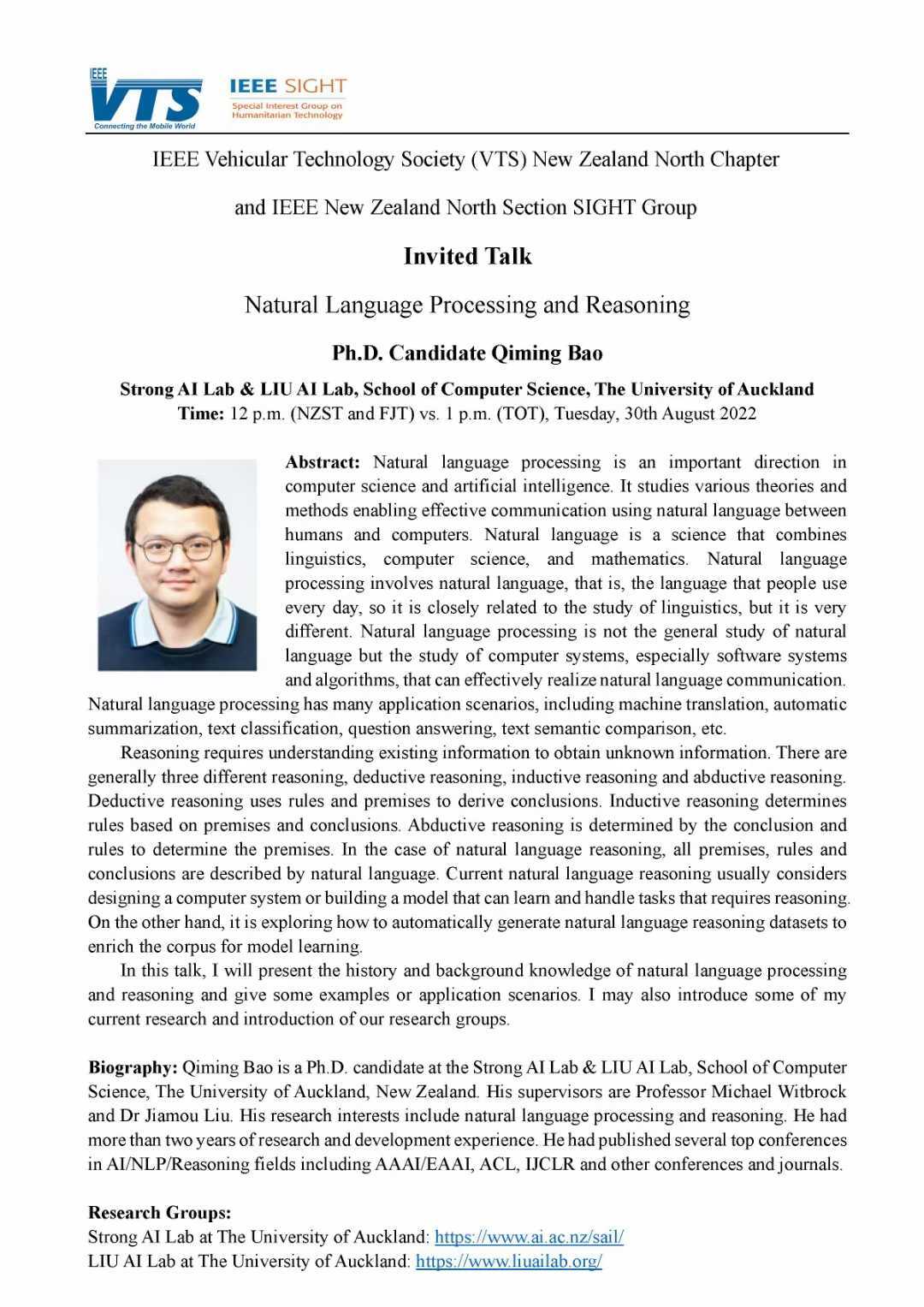
IEEE Vehicular Technology Society (VTS) New Zealand North Chapter and IEEE New Zealand North Section SIGHT Group 2022 invited by Dr. William Liu (Invitation Letter) (Presentation Slide) (Recording)
ZJU-NLP Group, Zhejiang University 2023 invited by Prof. Huajun Chen and Prof. Ningrui Zhang
Shanghai AI Lab 2023 invited by Dr. Shuyue Hu and Dr. Yang Chen
NLP Group, The University of Melbourne Invited Talk 2023 invited by Mr. Ming-Bin Chen and Dr. Jey Han Lau (Invitation Letter) (Presentation Slide)
Institute of Automation, Chinese Academy of Sciences Invited Talk 2023 (Invitation Poster) (Presentation Slide)
Shenzhen MSU-BIT University Invited Talk 2024 (Invitation Letter) (Presentation Slide)
University of Massachusetts - Amherst Invited Talk 2024 invited by Prof. Andrew Lan (Invitation Letter) (Presentation Slide)
Penn State University & University of Auckland Online Workshop 2024 Day 1 Session 2 Children's Future, Intercultural Learning (Invitation Letter) (Presentation Slide) (Recording)
Logic and AI Seminar 2025 (Tsinghua University & Peking University) invited by Prof. Fenrong Liu and A/Prof. Haoxuan Li (Invitation Letter)
Max Planck Institute For Software Systems invited by Prof. Adish Singla (Invitation Letter) (Presentation Slide)
Technical University of Munich invited by Dr. Stefan Fuchs and Prof. Dr.-Ing. André Borrmann (Invitation Letter)
Zhejiang University 2026 Invitation Talk 2026 (Program Committee) (Core Rank: A*, CCF Rank: A)
EMNLP 2025 (Reviewer) (Core Rank: A*, CCF Rank: B)
COLM 2025 (Reviewer) (Top LLM Conference)
NAACL 2024 (Reviewer) (Core Rank: A, CCF Rank: B)
ICONIP 2024/2025 (Program Committee) (Core Rank: B, CCF Rank: C)
IJCLR 2024, Nanjing, China (Program Committee) (CCF Rank: C)
NuCLeaR@AAAI 2024, Vancouver, Canada (Program Committee) (Core Rank: A*, CCF Rank: A)
ECAI 2023, Kraków, Poland (Program Committee) (Core Rank: A, CCF Rank: B)
ACL 2022 (Reviewer) (Core Rank: A*, CCF Rank: A)
NLPCC 2021/2022/2023 (Program Committee) (CCF Rank: C)
Journal Reviewer
Knowledge-based Systems 2024 (SCI, IF:8.8, JCR Q1)
International Journal of Artificial Intelligence in Education 2024 (SCI, IF:4.9, JCR Q1)
IEEE/ACM Transactions on Computational Biology and Bioinformatics 2022 (SCI, IF:3.71, CCF Rank B, JCR Q1)
Teaching/Grant Experience and Other Achievements
Chinese IT Association NZ Guest Presenter (CITA分享嘉宾)
DAAD AINeT fellow 2025 on Natural Language Processing
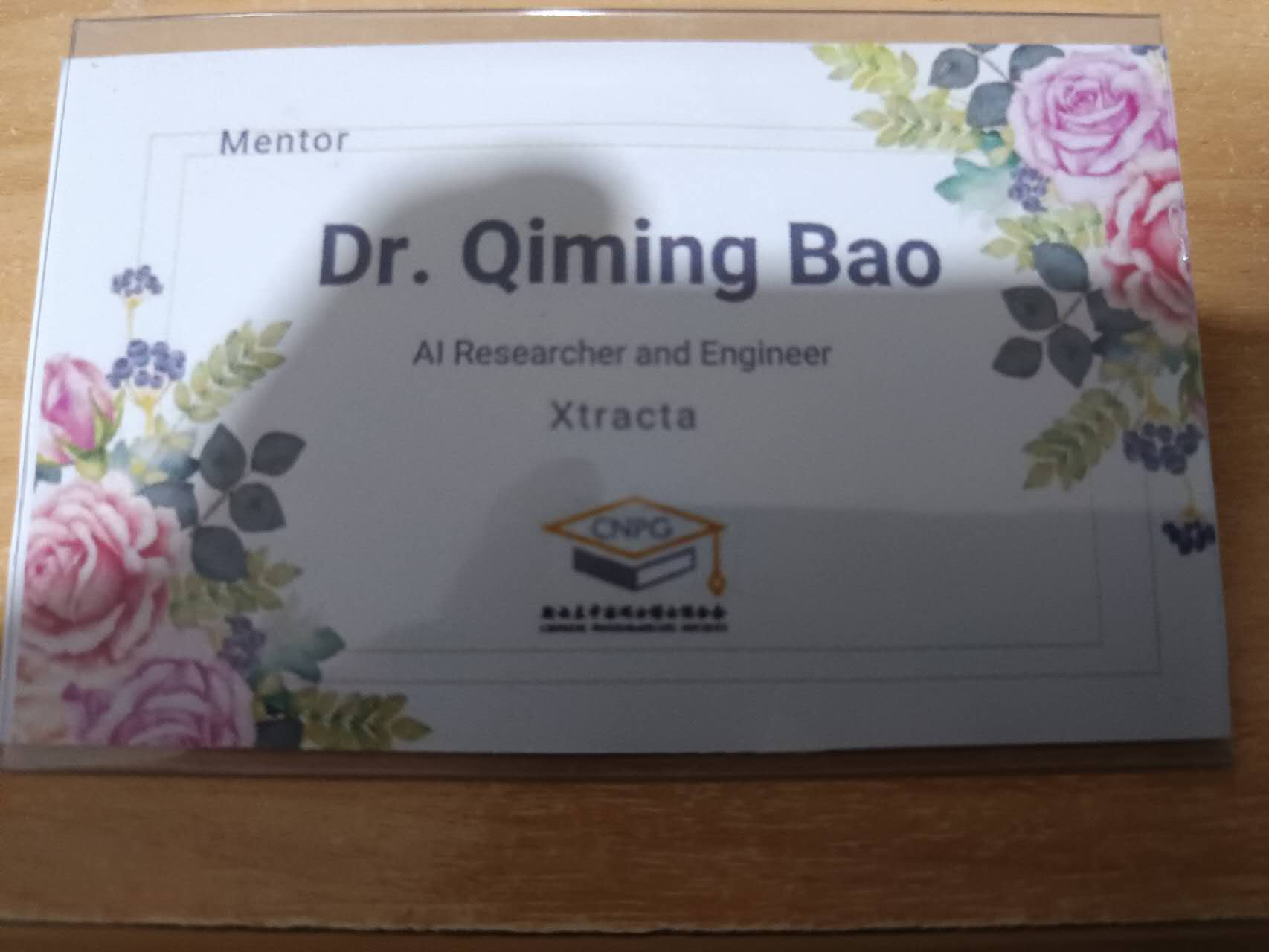
Chinese Postgraduate Society Career Development Mentor (CNPG职业发展导师)
AAAI 2025 Travel Award
Vice President of Australia and New Zealand Alumni Association of China Jiliang University (中国计量大学澳新校友会副会长)
Outstanding PhD student of the Faculty of Science, University of Auckland
PhD Extension Award, University of Auckland
The Computer Science Graduate Student Travel (CSGST) Award 2023 & 2024, University of Auckland
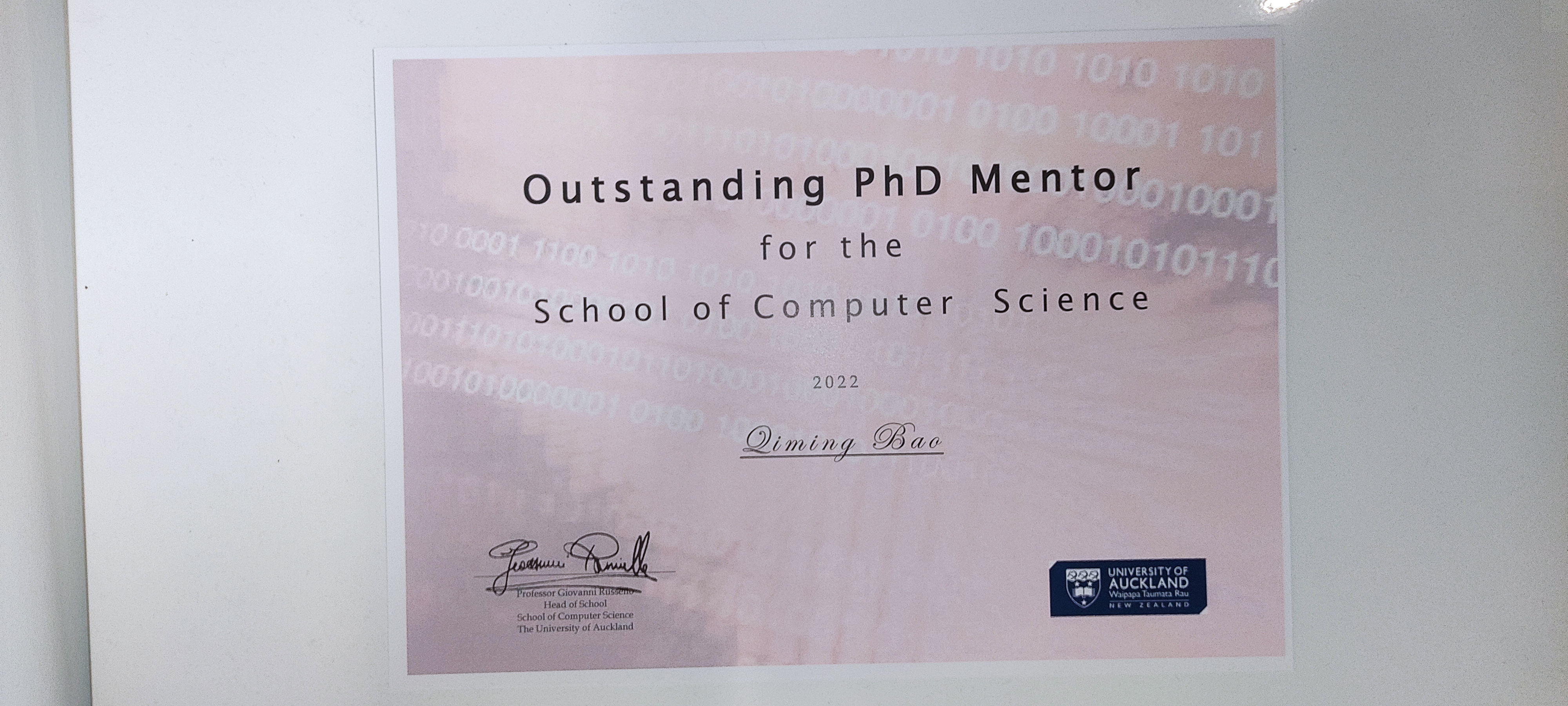
PhD Mentor (Outstanding PhD Mentor, School of Computer Science, University of Auckland)
The Research & Development Tax Incentive (RDTI) Grants, Callaghan Innovation (New Zealand's Innovation Agency)
PhD Research Project Scholarship, University of Auckland
First-Class Honours, University of Auckland
Precision Driven Health & Orion Health Summer Scholarship
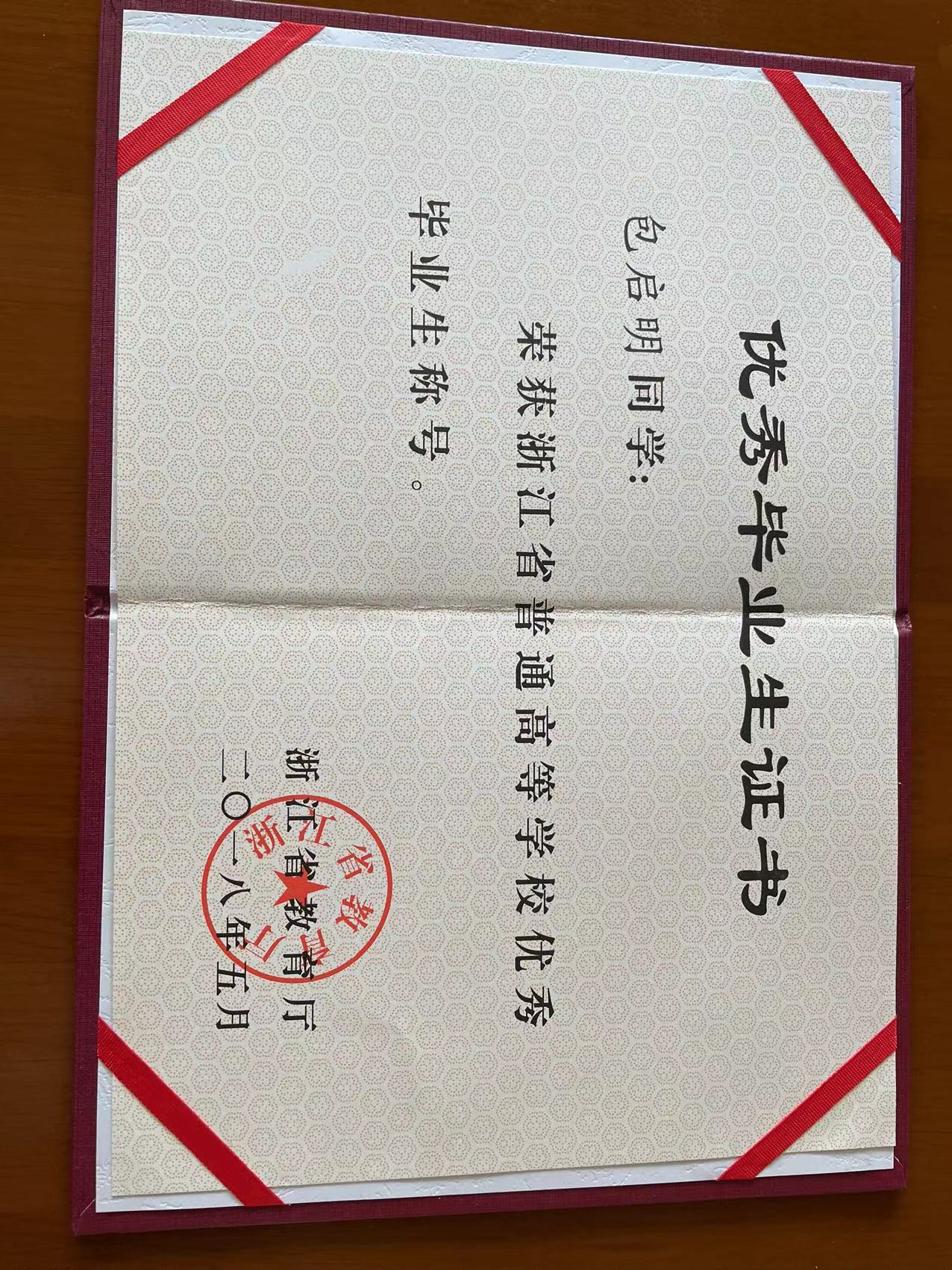
Outstanding Graduate Student, Zhejiang Province (Top 1%)
The Honourable Mention of 2018 Interdisciplinary Contest In Modeling (Top 10%)
Outstanding Graduates of Hangzhou No.11 High School (杭十一中优秀毕业校友)
Outstanding Graduates of China Jiliang University (中国计量大学优秀毕业校友)
The 5th International Young Scholars Forum of China Jiliang University (中国计量大学第五届国际青年学者论坛, Top 5%)
The University of Auckland
COMPSCI 110 Introduction to Computer Systems (Course Marker)
COMPSCI 220 Algorithms and Data Structures (Tutor)
COMPSCI 235 Software Development Methodologies (Tutor for students from both University of Auckland and Southwest University)
SOFTENG 325 Software Architecture (Tutor)
COMPSCI 367 Artificial Intelligence (Course Marker)
COMPSCI 399 Capstone: Computer Science (Tutor/Project Supervisor)
COMPSCI 703 Generalising Artificial Intelligence (Tutor/Guest Lecturer)
COMPSCI 778 Master of Information Technology Internship Mentor
Lab Demonstrator
Monash University & Southeast University Joint Graduate School (Monash-SEU JGS)
FIT5046 Mobile and Distributed Computing Systems (Teaching Assistant for Master's Programs)